
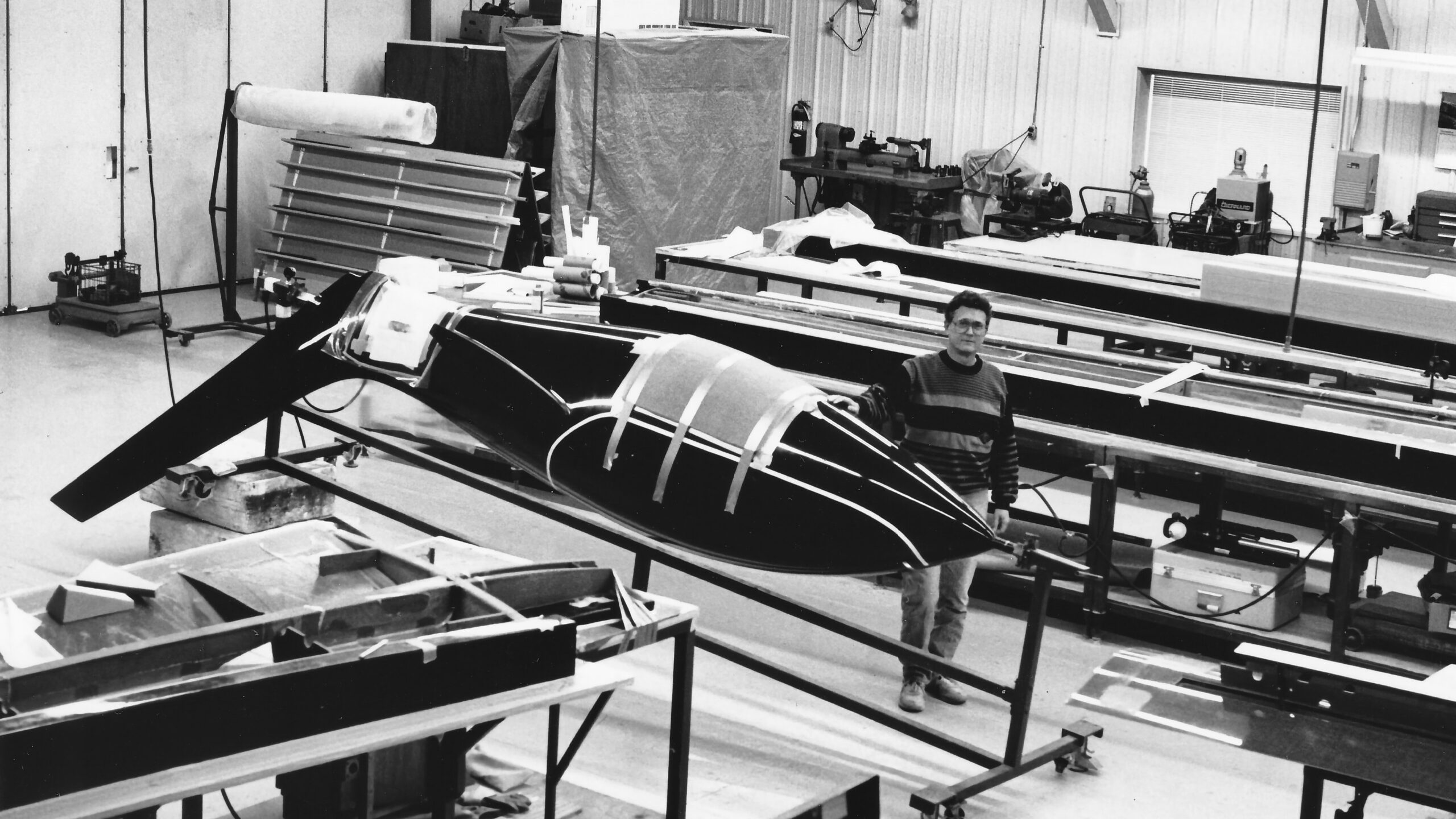
The air inside the Group Genesis facility in November 1993 carried the unmistakable scent of curing composite resins, sawdust, and raw ambition. Tucked away from mainstream commercial aviation, a small group of thinkers gathered around a radical shape taking form on the workshop floor. Captured in these black and white snapshots is a moment where some of the most unconventional minds in aerospace engineering crossed paths, unified by a shared refusal to let traditional design dictate the future of flight.
At the center of the primary gathering stands Jim Marske, framed by fellow pioneers Jeremy Harris and William Foshag. The accompanying images reveal the sleek, carbon reinforced skeletal frame of what would become the Genesis flying wing sport sailplane, while additional views capture Jim working directly over the massive wing assembly jigs. These rare images, captured by Harris and preserved through the years by legendary engineer James DeLaurier, offer a window into a golden era of experimental aviation.
A Synergy of Mavericks
To understand the weight of this meeting, one must look at the invisible threads connecting these men. Jim Marske had already established himself as a master of tailless flight, proving to the world that an aircraft could achieve beautiful, self stable equilibrium without a traditional tail structure. When the Genesis Group formed, it sought to create a standard class high performance glider that could outperform the best conventional sailplanes in the world. They looked directly to the principles of natural wing stability that Jim had spent his lifetime refining. More details on the technical design goals and history of this unique aircraft can be explored through historical archives.

Standing next to Jim was William Foshag, a brilliant aeronautical engineer whose curiosity knew no bounds. Foshag spent his career exploring the fringes of flight, leaving his mark on everything from vertical takeoff platforms to early single blade monocopters. On the other side stood Jeremy Harris, a gifted engineer who, alongside James DeLaurier, committed decades of research to achieving what many believed was mathematically impossible. Harris and DeLaurier eventually made aviation history by designing and building a successful engine powered ornithopter, a historic achievement detailed by General Aviation News.
As a sidenote, William Foshag played a vital role in preserving a unique piece of tailless aviation history by arranging the donation of a custom-built Marske Pioneer II to the Mid-Atlantic Air Museum. He had carefully stored the sailplane inside a historic Pennsylvania mill in 1977, where it remained safely suspended from the upper beams for decades. His initial outreach kept the preservation efforts alive, allowing museum crews to later extract the weathered glider and fulfill his wish to safeguard its legacy.
The Flying Wing Chapter Connection
The deep mutual respect shared by these innovators eventually rippled from the workshop floor into the pages of academic literature. Years after this workshop gathering, DeLaurier codified his decades of aerospace engineering insights into his definitive textbook, Aircraft Design Concepts An Introductory Course.
When it came time to write Chapter 4, which is dedicated entirely to the complex physics of flying wings and tailless airplanes, DeLaurier knew exactly where to look for real world validation. Jim Marske directly contributed his extensive practical insights, illustrations, and photographs to the chapter. By blending Marske’s hands on expertise with rigorous aerodynamic theory, the textbook provides students with a rare bridge between abstract formulas and actual, successful flight achievements.
Crafting the Self Stable Wing
The physical focus of their 1993 gathering, the Genesis sailplane, was an aerodynamic marvel. Conventional gliders relied on long, drag heavy rear fuselages and large horizontal tails to maintain balance. The Genesis group discarded that playbook, creating a self stable wing utilizing advanced composite materials and a highly precise reverse sweep. This engineering choice kept the variable weights concentrated perfectly at the center of gravity, yielding an aircraft that resisted spins and offered unmatched low speed handling.
Looking at the photos, one can see the raw marriage of theory and manual craftsmanship. Building a flying wing requires an absolute commitment to precision. Every curve of the spar and every millimeter of skin contour dictates whether the wing will fly true or succumb to pitch instability. The men in that room did not just analyze formulas on paper; they rolled up their sleeves and built the future with their own hands.

A Shared Aerospace Legacy
These historic photographs serve as a poignant reminder that breakthroughs are rarely born in isolation. They emerge from a community of dreamers who share notes, critique designs, and celebrate the sheer joy of pushing boundaries. Thanks to the generosity of Jeremy Harris and the careful archiving of James DeLaurier, this story can be shared here today. The Genesis project successfully demonstrated that the sky belongs to those who dare to rethink its rules. Decades after these photographs were taken, the spirit of that November day continues to inspire a community of builders who look up at the clouds and see infinite possibilities waiting to take wing.
Join the conversation.