
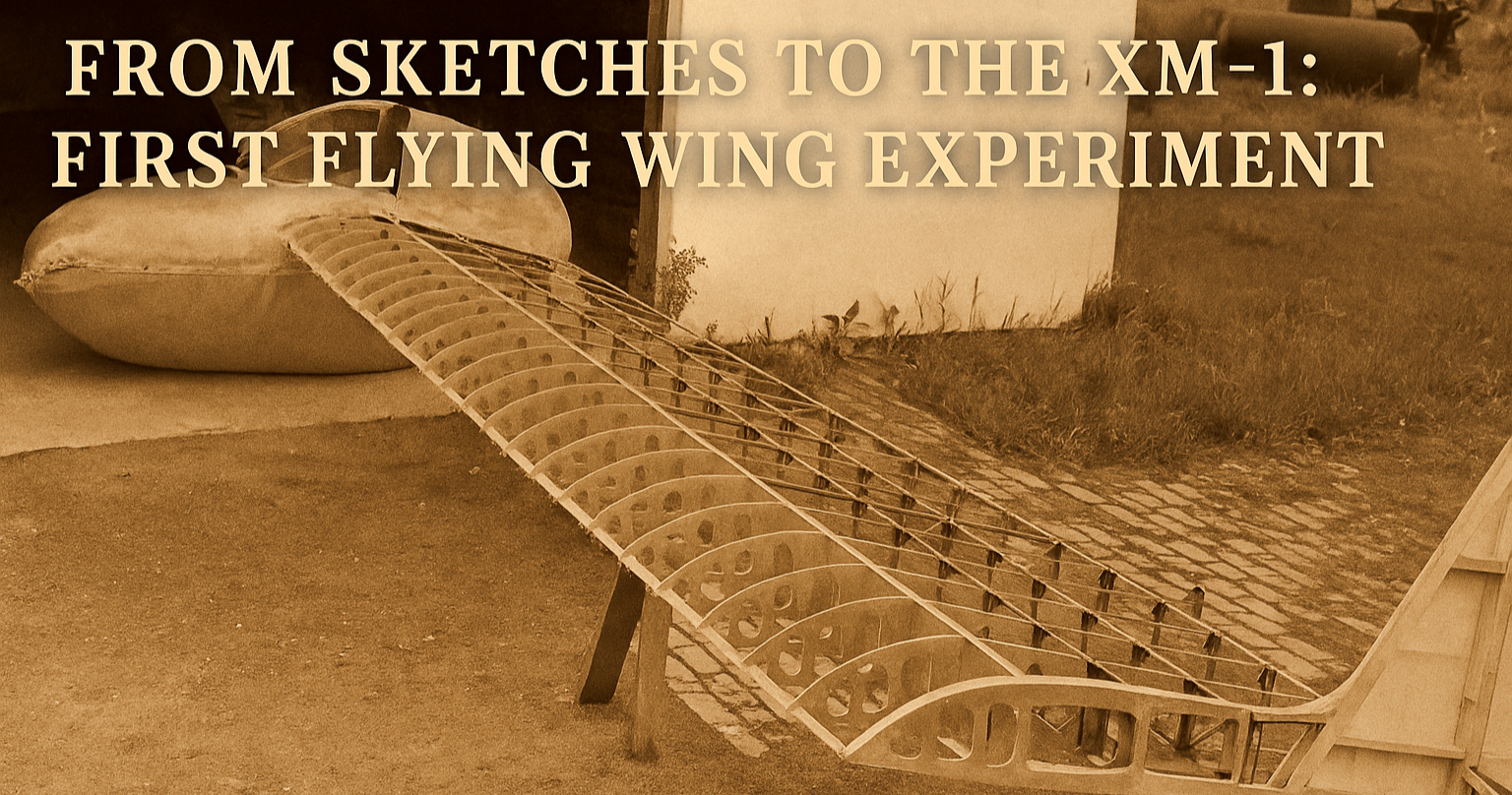
Basement sketches, homemade parts, and the leap from dreams of soaring to building his first experimental flying wing.
As Jim’s journey in soaring continued, the near-disastrous lessons of the $160 basket-case glider only strengthened his resolve. No longer satisfied with repairing or restoring what others had built, he turned his attention inward — to sketches, ideas, and experiments of his own. What began in the quiet corners of his basement soon became the XM-1, his very first attempt at creating a man-carrying flying wing.
From Sketches to the XM-1: First Flying Wing Experiment
As Jim’s journey in soaring continued, the near-disastrous lessons of the $160 basket-case glider only strengthened his resolve. No longer satisfied with repairing or restoring what others had built, he turned his attention inward — to sketches, ideas, and experiments of his own. What began in the quiet corners of his basement soon became the XM-1, his very first attempt at creating a man-carrying flying wing.
Early Sketches and Basement Work
By his mid-teens, Jim was filling notebooks with drawings of gliders and wings that looked different from anything else in the sky. He wanted to understand how flight worked at a deeper level and believed that removing the tail was the key to a new kind of sailplane. In his basement workshop, he cut wood, shaped ribs, and assembled simple frames, learning by trial and error with every piece he built. “I didn’t even know what I was doing at the time,” Jim said, “but I had this feeling that I was working toward something that would fly without a tail.”
Building Toward a Vision
The materials were basic — spare wood, fabric, and whatever fasteners he could find — yet the effort gave Jim a growing confidence. Piece by piece, he was no longer just copying what others had designed, but exploring his own path. The more he worked, the clearer his vision became: to design and build a true flying wing that could carry a pilot into the air. These experiments marked his first steps toward a lifetime of original design.
The XM-1 Takes Form
From these beginnings, Jim created the XM-1, a simple and experimental flying wing glider that reflected both his ambition and his inexperience. It was not sleek or refined, but it represented his first attempt to turn sketches and dreams into an aircraft he could actually fly. “I had no real guidance,” Jim recalled, “just a stubborn belief that flying wings could be built and flown.” The XM-1 may not have achieved lasting fame, but for Jim, it was the proof that he could move from imagination to reality.
Lessons in Design and Determination
Working on the XM-1 gave Jim his earliest lessons in the challenges of creating new aircraft. He quickly learned how easy it was to make mistakes and how unforgiving those mistakes could be in the air. But he also discovered that persistence and problem-solving could move him forward, even when the results were imperfect. “Looking back, it was crude, but it was the start,” he said. Every design that followed carried the influence of those early basement experiments.
Share Your Thoughts
This is the third story in our series, Jim Marske: In His Own Words. Have you ever tried building something before you fully understood it? Share your reflections with the Marske community in the comments below.
Join the conversation.